
 Posted by TheBird on Mar 11, 2026
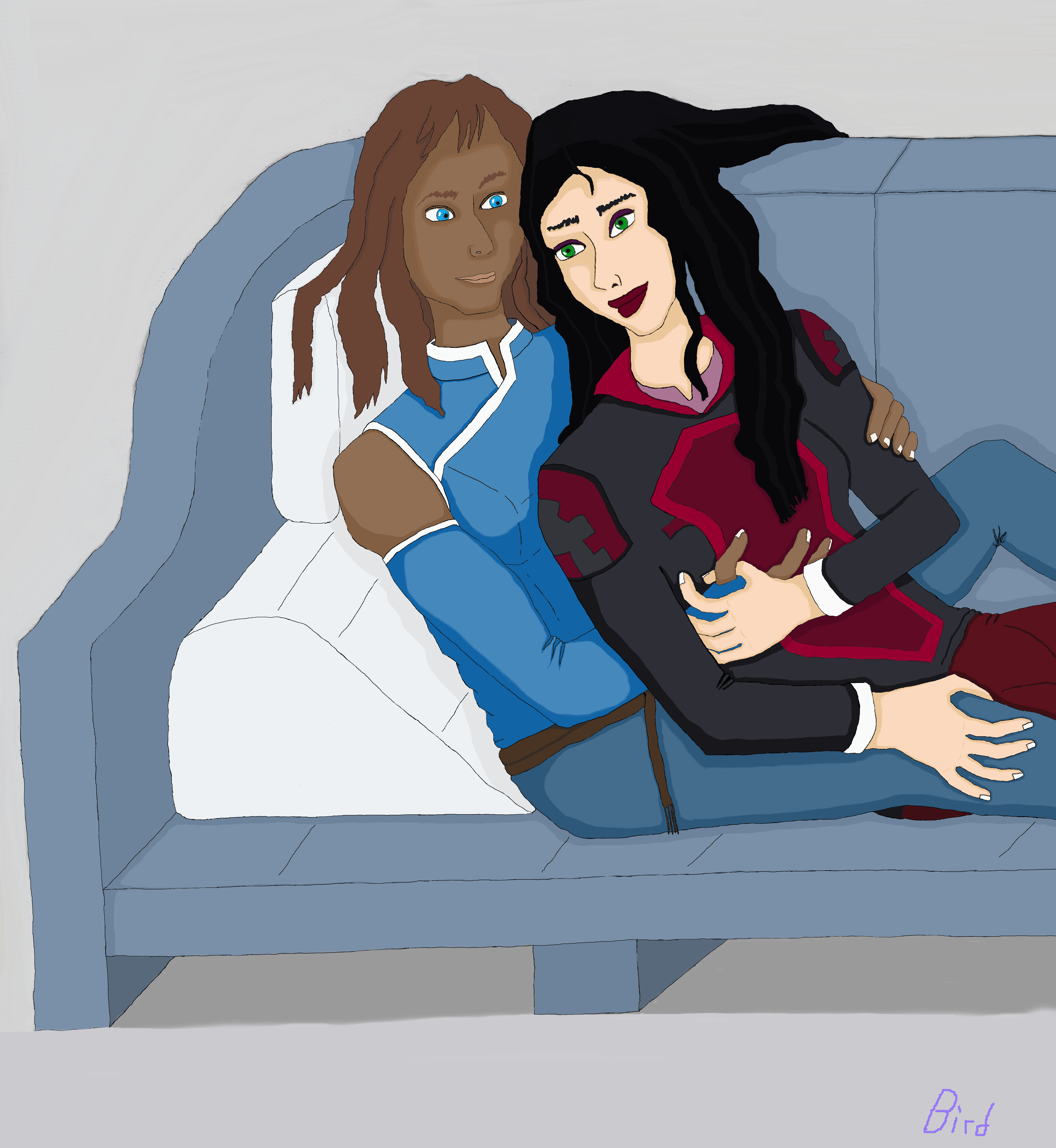
I have been in and out of hospital and recovering so didn't write much. This post will use some of my notes and theories notes from my research on the Avater-verse for my Legend of Korra fanfiction. The beginning question comes from a conversation with a former friend and reader of the TLOK fanfiction tales. I also posted this to my tumblr.
The image above is a drawing of Korra laying on a sofa with Asami leaning back against her. I originally drew by hand, but then scanned it in and digitally colored it.
Can bending stop or alter the trajectory of a bullet from a 1920s/30s style gun?
How about air?
Per calculations, air benders could indeed slow the bullet but whether they produce enough drag to save themselves depends on their bending skill and how far the shooter is.
So say, an air bender faces off with a gun expert. They bend a huge burst of air at the gun the moment the gun is lifted, which would create a much larger drag force than just normal air. This slows the bullet and drops the trajectory estimate significantly. I used the parameters of a .308 bullet (since I don't know what the shape/area of a bullet will be for this universe).
Without any bending and assuming the bullet is 400 m/s using .308 data in normal air conditions (no gusts), the trajectory is about 163 meters. So gonna put that air bender at 100 meters from the shooter. Drag force would need to be 0.55 N if they're that close, but to get the bullet to slow down enough to not hit them, they need to bend air at a speed of 80 m/s.
How fast is air blasts anyway?
When Korra did that first airbending kick to knock Amon out of the building, that required quite a lot of force to turn him into a projectile. So can a typical air bender produce winds above 80 m/s? To launch a person (estimating weight around 55 kg), approx 45 m/s to push them. In Korra's fight with Amon, gravity aided her once she blasted him out of that building.
However, the air bender needs at least 80 m/s to slow that bullet. Shooting a gust at 45 m/s at the assailant won't slow or divert the bullet, but it will launch the shooter. The air bender would still be hit if they failed to launch the shooter before the shot is taken.
Sniping from a far distance would only work against air benders if the sniper was well hidden and maybe had a silencer. Otherwise, if they're seen, the air blast could shorten or alter trajectory to save the air bender. Trying to calculate a human being as a projectile become increasingly complicated, so I'm not sure if I'm under or over estimating Air blasts.
How about water?
Due to the way water creates friction and slows the speed of projectiles, a thick enough wall of water could slow a bullet. Using the same bullet parameters above, water benders can survive if they are at least 1.2 meters away with a wall of 1.22 meters of water.
So then what of fire?
Bullets are predominantly made of lead mixed with minor amounts of copper, steel, and/or brass. Copper has a relatively high melting point of 1,083 degrees Celsius, but lead has lower melting point of 327.5 °C, while brass melts at 1000 °C. Steel's melting point depends on its type. Stainless steel melts at 1363°C while medium or low carbon steel melts at a higher temperature of 1427 to 1464°C.
This would require fire bending to reach temperatures of at least 1300 °C to melt majority of the bullet. The show often presents fire as red and orange in coloration.
Fire as a range of colors that encompass almost the entirety of the rainbow. Even red fire has differences in heat based on how red the fire is.
For example dull red fire that is barely visible is approximately 525 °C, but as it grows stronger it changes from dull cherry-red at 800 °C to full cherry-red at 900 °C to finally clear cherry-red at 1000 °C.
Orange flames has two common variations: deep orange burns at 1,100 °C and clear orange flames at 1,200 °C.
So if we go with only red and orange for the flames, that's not hot enough to melt a bullet.
What of Azula's blue flames?
Again there's some variation in the burn with a duller blue being 2,500 °C and a more clear, bright blue being 3,000 °C. Blue is a much, much hotter fire than red or orange (or even white, which burns around 1400°C).
This puts Azula much closer to being able to melt a bullet, but it means the average fire bender could not melt the bullet.
Even melting the gun would require Azula-level of heat, which most fire benders do not seem to be able to do.
What of lightning? How hot can lightning become?
Lightning is the movement of an electrical charge, so the movement itself doesn't have any heat. It's the resistance to that movement that causes the heat. If the lightning passes through a good conductor like a metal such as copper, then very little heat is created.
However, if lightning passes through a poor conductor such as air, it can heat up the air to almost 27,760 degrees Celsius! This is five times hotter than the surface of the sun.
Lightning bending requires precision, careful breathwork, and time to produce the lighting. If fire benders can produce the lighting in time to fire at the shooter before the trigger is pulled, it would slam into the bullet just as it leaves the gun and melt it. It'd also shock the shooter.
Would the lightning kill the shooter? Not necessarily. Humans are comprised of a lot of conductive elements, and the lightning will pass through the human to ground. They will be extremely hurt and it's possible might die of a heart-attack after, but humans have, in real life, survived being hit by lightning.
What of earth?
Gunpowder is a mixture of sulfur, charcoal (which is mostly carbon), and potassium nitrate (saltpeter). Of these, carbon, sulfur, and potassium exist in various amounts in soils and/or specific types of rock. Could an earth-bender latch onto some of the earth-based ingredients in gunpowder to stop the gun from firing?
Considering how earth bending seems to require latching on to at least two elements, see section below for reasoning why, it's possible they could latch onto gunpowder, but whether it is accessible to them through the metals they cannot bend is up for debate.
Earth benders are better off creating a several meters thick wall to block the bullet.
Is Earth bending overpowered?
This creates a complication in that earth-bending feels overpowered with earth bending, metal bending, and lava bending. Potentially adding gunpowder bending may push earth bending into an overpowered state over the other elements.
Fire bending is isolated to fire, heat, lighting, and combustion bending.
Air bending is isolated to air molecules.
Water bending consists of manipulating water molecules and blood bending.
This raises a question of whether water benders can bend oil, which is liquid + earth/carbon. Since Earth benders have lava bending, which is a combo of heat + earth, it makes sense within the world building's logic for water benders to be able to bend a liquid like oil.
For earth bending, the logic of the shows' worldbuilding is a trifle complicated.
In the Legend of Korra, "platinum" cannot be bent, which the show has "platinum" being incredibly strong metal. However, in real life, platinum is not at all a strong metal and is soft. That's why it's often used for jewelry not giant mechas.
This leads me to think "platinum" is actually titanium, as that metal is used for construction of heavy-duty equipment and buildings in real life.
Therefore, if earth-benders can't blend pure "platinum"/titanium, then this implies their bending requires more than one element for grappling.
Majority of Earth's rocks and soil is comprised of iron (32.1% by mass), oxygen (30.1%), silicon (15.1%), magnesium (13.9%), sulfur (2.9%), nickel (1.8%), calcium (1.5%), aluminum (1.4%), and remaining 1.2% consisting of trace amounts of other elements.
If the Avatar-verse's planet has a similar composition to our planet (which the show implies in its worldbuilding), then the elements of the soil would mostly fall in metalloids, polyatomic nonmetals, and monoatomic nonmetals. Of those, Iron is the only transitional metal and aluminum is the only post-transitional metal.
The show already established that nonmetals cannot be bended by earth-benders. However, metalloids, alloys, soil, and rock can be bended in the show.
Since Earthbenders are bending earth as a clump, they'd get all these elements tossed together in impure states. Which coupled with their in-universe inability to bend platinum/titanium implies that they can't bend the pure forms of these elements. It'd require precision earthbending fails to have.
My speculation for earthbending is that two different elements are needed for them to latch onto and that's how they bend the earth, but for a pure form of an element, there's only one element, and that's why they can't bend the pure forms.
This restriction also gives some limits to the powers of earth-bending as well.
What is the Science behind bending the other elements?
Air:
Air is comprised of a multitude of molecules, as in one to two elements bonded together, spread through the sky. They are thicker toward the ground, but grow less and less the farther away from the Earth's surface. Earth's gravity and rotational force keeps the atmosphere in place to a large extend.
Air bending seems to be far more precise than earth. Because in order to create the gusts, whirlwinds, blasts of air, an Air Bender must manipulate those randomly assorted particles and order them into a more precise orientation, then give them the momentum needed to move them at high speeds. Considering how Tenzin would sometimes slice with his air bending, he ordered the molecules into a precise ordered arrangement to create a knife made of air.
Since the universe tends toward disordered states (the law of entropy), this would require energy on the behalf of the air bender to mold the molecules into a highly ordered state. The skill of the air bender depends on how well they can create these ordered states of molecules.
Water:
Water in liquid form are molecules arranged in sheets that slide around each other loosely. While air has more random particles that jitter about, liquid particles are much closer together so the energetic motion of molecules is constrained within a closer arrangement. Thus, any force on liquid spreads from molecule to molecule fairly quick due to their closeness.
Arranging water into ice requires forming these semi-ordered molecules into a highly ordered crystalline structure. This would require precision and energy to once again go from a more disordered state to an ordered state.
This leaves the question of whether water benders can bend oil. First off, oil in its natural form exists either as animal by-products, such as whale oil or oil distilled from animal's flesh. Then there's the oil within the earth that is the result of plants and dead creatures compressed into an oily form. Water would still be present to some extent in the oil base.
Since blood-bending is a water bending skill, bending oil seems like it would be a subset of that. Oil often comes from the remains of living creatures, who had blood within their systems. Thus, manipulating oil as well seems logical in the framework of the current worldbuilding rules.
Fire:
Heat is the basis of fire. Without heat there is no fire. Lightning is also based in heat. Heat-bending seems to be a natural start for any fire bending.
Fire also has the weakness of being neutralized with an intense bout of water or suffocated by removing the air from it. Fire requires air to feed it.
Fire in its red and orange colorations may not require too much precision, but for hotter flames like blue immense concentration seems to be required based off Azula's depiction of that power.
Lighting is more complex because it requires the user to be able to manipulate the two energy points in their body -- the head and chest -- to pull energy and form the lightning.
Since lightning can't exist without two polarizing poles from which the fire bender manipulates, this would require concentration to not electrify oneself to death while practice. This is likely why not all fire benders are also lightning benders.
I appreciate the fact the worldbuilding uses two poles to form the lightning. This fits well the actual reality of lightning consisting of the movement of electric charge from one point to the next.
Energy bending:
This is the only bending which only the Avatar can do.
All of matter holds energy within it. All of reality is layered with energy. Matter can be converted into energy and vice versa. The universe is comprised of particles, which is the building blocks for all of the elements and other matter aspects of the universe. Particles' vibrations generate energy. Energy cannot be created or destroyed, but it can be manipulated into different forms.
Thus the Avatar is bending the energy of reality at the quantum level in order to transform/alter an aspect of that person's matter.
For example, when Korra's bending styles was cut-off by Amon, the former Avatars appeared for her to use energy-bending to restore her bending. It is theorized that Amon didn't eliminate bending, but twisted the pathways of the energy needed for bending within the body. Energy-bending then transformed the twisted pathways back into their former, healthier forms. It was a rearrangement of particles.
Amon used blood-bending to alter the pathways, and it's possible blood-bending could have been used to repair those pathways. However, the use of energy-bending, which goes to the quantum level of particles, would be faster and less painful of a method.
I theorize spirit bending relates to energy-bending due to this same methodology.