
 Posted by Joey Peters on Feb 25, 2026
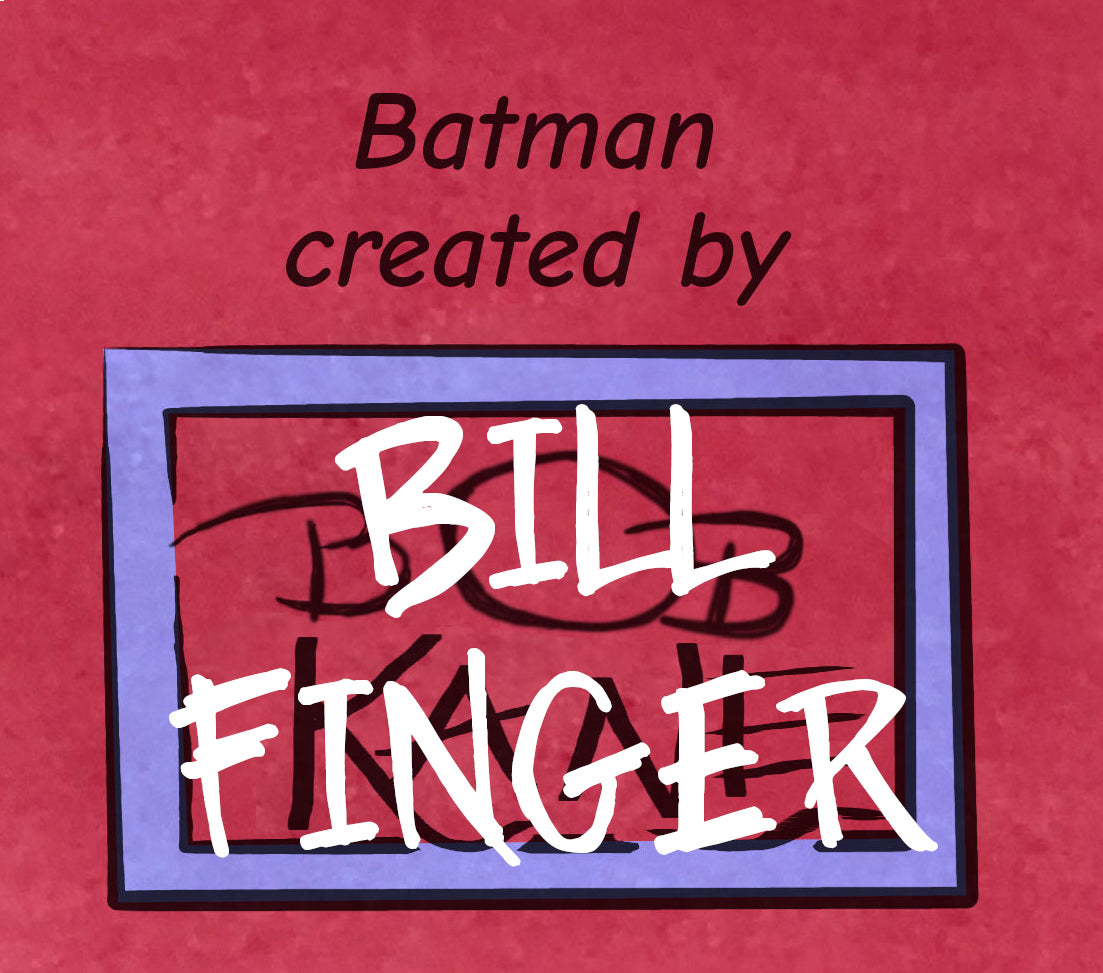
The Labor History of Comics #3: Batman created by Bill Finger
Batman is probably the most successful comic book character in history. He debuted in Detective Comics #27 and very soon afterwards joined the ranks of Superman, with adaptations into adventure serials, radio plays, cartoons, television shows, and underpants.
Now Batman is a ubiquitous character who has largely conquered pop culture. There are myriad characters who clearly draw from Batman. Moon Knight is mystic insane Batman. Nighthawk is wink-and-nod Batman but owned by Marvel. Midnighter is what if Batman was gay with Superman? The Dan Drieberg Nite Owl is Batman in a less cartoonish and deranged world (for the record this is actually incorrect, but you need a wealth of comic book knowledge to understand it so so large that it’s fine to round it down to this, like the Bohr model of the atom).
I don’t really need to explain who or what Batman is. Rich child, murdered parents, bat crashes through window, I shall become a bat. He has been a ubiquitous pop culture character since before my parents were born and I’m in my mid 40’s, and in my lifetime he has become one of the dominant fictional personages of our society.
What I want to do here is tell the story of Batman’s creation and the stories of his creators, most particularly Bill Finger. Up until fairly recently every licensed Batman product would include somewhere within it “Batman created by Bob Kane.” Bob Kane was a real guy who was really involved in the creation of Batman, although that’s not the whole story. These days most of those will feature Bob Kane and Bill Finger.
Typically early comic books were attributed solely to the artist, and many of those names were pseudonyms or house names at any rate. Often comics were the product of a writer, someone who defined the line art in pencil, someone who fleshed out the line art in ink, a letterer and a colorist at the time and only a few rare cranks did all the work for their comics.
As comic books became larger pop culture products publishers tried to minimize and erase the creators therein. For decades the fans of Disney Comics speculated on the different styles present in the comics, with one “Good Duck Artist” recognized as the best of the bunch. But ultimately they were all credited to Walt Disney, specifically to deny the artists working on the books recognition and better pay. The Good Duck Artist remained anonymous until the end of the 50’s, when the emerging fandom identified him as Carl Barks. He would be another good subject for a future Labor History of Comics piece.
After the shock success of Action Comics and it’s attendant hero Superman publishers panicked and did everything they could to publish as many comic books as possible. National Publications, being the publishers of Action Comics were well positioned to produce many of these comics, and their proximity to Action Comics would help them with distribution. Detective Comics, initially an anthology of various pulpy adventure stories, was rushed into development.
Comics at the time were organized into anthologies. They collected short stories around some kind of theme. Action Comics, Detective Comics, Jungle Comics, Fight Comics, et cetera. Most of the content for these books were slapped together in packaging houses, which were essentially factories for making comics. The smaller, newer and less legitimate publishers would use these to fill the pages of their comics. National Publications, standing on the success of their titles, instead had a system more akin to a bullpen and more direct editorial contact and control over their books.
These early comics often drew inspiration from other cheap working class media of the time, most especially the pulps. Pulps were cheaply produced prose content in magazines and novels which told lurid exciting stories. Manly men would fist fight deadly leopards or cannibalistic tribesmen or whatever other thing that hasn’t aged well. They were cheap, disposable entertainment for the masses. Comics very quickly became another wing of that.
That brings us to Detective Comics. This was another of National Publications anthology books. After the success of Superman they put out a call among their creatives for more colorful costumed vigilantes. Bob Kane was a young artist working for them. He called Bill Finger to get get critiques for the character he cooked up. This character was pretty standard among the emerging flood of superheroes; a guy in a red leotard with a domino mask and large burly wings. Finger made some important adjustments to Kane’s first draft: a gray body suit, a head covering cowl, and replace the wings with a flowing cape.
Batman debuted in Detective Comics #27 in spring 1939. Batman,barring some more pulpy aspects to his character (he used guns) was more or less recognizable to the modern incarnation. To say the Batman was popular would be an understatement. My god, eventually National Publications changed it’s name to DC Comics in recognition of the importance of Detective Comics. Bill Finger wrote these initial outings with art by Bob Kane.
Very quickly Kane established a “studio,” where he would hire artists to help with various aspects of the comic’s creation. Jerry Robinson (another important figure to whom we owe much of the Batman mythos) inked Kane’s line art. George Roussos drafted a lot of the boring background pencilling. And again, the entire comic was credited to Bob Kane, who quickly became a house name for National Publications.
In addition to his prodigious use of ghost artists, he also attempted to maintain maximal credit of everything he could plausibly claim to have done. He would at least credit his writer, Bill Finger, in the creation of the Joker but he always minimized the role of Jerry Robinson in that (I would probably rate Joker as a certified Bill Finger and Jerry Robinson joint).
Kane himself eventually moved on to the Batman comic strip, which was seen as more prestigious and was better paying. In 1946 the Batman comic strip ended. During this time Superman co-creators Jerry Siegel and Joe Shuster attempted to renegotiate their contract. They contacted Kane about joining them so that National’s most well known creators could create a united front. Kane instead narced out Siegel and Shuster and renegotiated a new contract on his own.
Allegedy, one of the cudgels he used in these negotiations was that he signed his original contract with DC Comics before he turned 18, and therefore it was invalid. Kane’s accepted year of birth is 1915 and even being generous with the dating of his original contract with National the math doesn’t square for that. The cover date for Detective Comics #27 is May 1939, which means that it was released a few months before that and May was the date that newsstands were to take the magazine down, destroy it and get a refund for unsold books. Lead times for publications were much longer back then, but even assuming a full year he still would have been twenty-three at least.
It’s a good grift if you can get it.
Kane was a constructed character and a figure head for Batman. Whenever there was new important Batman media he would get trotted out to shellack the legacy of. He still “worked” for DC comics after this new contract, with new pages produced by ghost artists such as Sheldon Moldoff, until the Adam West Batman series. Kane attempted to move into fine art as the respected creator of a pop culture icon. If you are in the know with comic creators there are many backroom stories about Kane’s ghosts—sometimes including the ghosts who produced his supposed fine art.
He lived a long successful life, eventually beefing it surrounded by loved ones in a golden mansion in 1998. This is in sharp contrast with every other comic book creator, except Stan Lee, who was a smilar figurehead for Marvel Comics. But most especially it stands in sharp contrast with Bill Finger.
Bill Finger was one of the primary writers on Batman. He at the very least co-created many of Batman’s most important side characters, including Robin, the Joker(this is slightly contentious but I side on him co-creating with Jerry Robinson and Bob Kane again taking credit), Catwoman, Riddler, Two-Face, Scarecrow, the Penguin, as well as a panoply of fan favorite Batman villains that normies haven’t heard of. More than anyone else he defined the world of Batman (up to and including naming Gotham City). Most of this was while ghost writing for Batman.
Eventually he was hired directly by National. Finger was a jobber writer, always in the background putting in good work. A jobber being a term from wrestling for someone with technical skill whose job is to make the stars look heroic.
The pay for a writer in this period was slim. He picked up some gigs writing for Hollywood, including for the Adam West Batman series. He was never a “name” writer during his lifetime.
He died from heart disease in 1974 aged 59.
Initially his son tried to build greater recognition for his contributions to our shared culture, but he too died young.
After Finger’s death Kane expressed at least a little bit of openness about Finger’s contributions to Batman. If I had to editorialize I expect he had some sense of personal shame about hiring so many people to work secretly for him across his entire career, and you could corner him on Batman specifically, because Finger contributed so much of what made the character recognizable.
Bill Finger was an open secret among comic book writers and artists, a cautionary tale of what can happen if your contributions to our culture are not recognized and compensated. His death predated the increased push later on into the 70’s and 80’s for creator ownership for creative work within the comic book industry. But for the most part this was known by the segment of comic book fandom that crossed over slightly with creators and no one else really knew.
That began to change with the graphic biography Bill the Boy Wonder written by Marc Tyler Nobleman and with art by Ty Templeton. In the process of writing the work Nobleman contacted Athena Finger, Bill Finger’s granddaughter. Ultimately this brought the existance and importance of Bill Finger to the greater comic book fandom and inspired Athena to begin a campaign to get Bill Finger his proper recognition.
In this late day there’s much less financial liability represented by DC Comics giving Bill Finger the proper credit he deserves, and they can use any lagresse pointed at Athena Finger as advertising for their good behavior. We have changed.
And indeed, contracts do tend to include creator participation clauses(these mean that creators can be paid a small amount if their creations are reprinted or adapted into other forms of media), and if you are big and important enough some level of creator ownership. But still as I’ve noted in other episodes of the labor history of comics, page rates haven’t increased since the 1970’s, not adjusted for inflation.
And in truth I don’t get the impression they’ve given Athena Finger much more than tokens, and proper credit for her grandfather. I think they should give her a serious cut of the mega-profits Batman has made across the last nearly a century and of course they would never do this.
But now when you go see a Batman movie it will say “Batman created by Bob Kane and Bill Finger,” which isn’t much, but it’s more than nothing.
Sources
https://medium.com/@JVNichols/the-creator-s-of-batman-f544ff30726f
A cynical reevaluation of Bob Kane’s legacy
https://www.reddit.com/r/DCcomics/comments/1mjxhm/batmans_greatest_villain_his_supposed_creator_bob/
A mean shit post breaking down what Bob Kane created versus Bill Finger
https://comicvine.gamespot.com/bob-kane/4040-19137/
Men of Tomorrow: Geeks, Gangsters, and the Birth of the Comic Book by Gerard Jones
The source of the claim that Bob Kane claimed to be underage while renegotiating his contract with National Publications, has a lot of interesting stuff about the development of the early comic book industry
Bill the Boy Wonder by Marc Tyler Nobleman and Ty Templeton
This book took what was common knowledge among comic book creators and spread the knoweldge to the greater comics fandom.