
 Posted by h3xtacy on Nov 14, 2025
Note Jan 16 2026: the word "childish" was replaced by the word "immature" because lots of young people have maturity and awareness more developed than fully grown adults.
It is Indigenous People’s History Month in the US right now and I am exhausted by the task of educating non-Natives on our history. So instead this month’s newsletter will be about some aspects of performance art and culture that have been stewing in the back of my mind for many years. Having a newsletter means I can write about whatever I want. :)
As the season slides deeper into Autumn in the northern hemisphere and it’s gentle darkness I find myself still busy with the art shows and the fundraisers and the general business of what seems like a good summer as a professional artist. I’ve been lucky enough to participate in body based research this year, which has been more and more rare as I’ve gotten older and had less access to decent medical care, and I’ve been thinking a lot about performance art and the places we choose to take ourselves; limits, edges, psychological cliffs, political conflicts, social suicide, financial ruin, physical risk. All creative work requires risk. All revolutionary work requires risk.
As a young person the most visible performance artists in my general area were musicians. And the Infernal Noise Brigade and Tch’Kung! were some of the most risky. Both projects had interconnected community members, one was explicitly anarchist and had a reputation for starting riots; the other was a marching band that played at protests and regularly charged the police line. Since this was the early 2000’s, the police in most places were not as militarized as they are now. A marching band approaching a police line was often taken as a joke, until they didn’t stop marching and pushed directly through. Someone associated with the INB once told me that part of their praxis was pushing the edges of performance art as far as they could, and for them that meant inciting (with brass and drums) anticapitalist and anti globalization dance parties across the world. I don’t know if this was the motivation of all members of the band, but it stuck with me.
What is our personal farthest point? How much can we push ourselves? Do we want to?
In a world where COVID exists and people are all very, very tired the hunger, the need to reach extremes and to “be extreme” that permeated the 1990’s and 2000’s culture feels distant and immature at times but very familiar, it is still coloring our current milieu in ways we don’t always recognize.
Around that same time in the early 2000’s I was attending fetish and BDSM events. As a young person these parties were mostly uninteresting; generally heterosexual white people with money getting drunk while wearing (sometimes racist) costumes and telling each other how dangerous and edgy and smart they are for it. As an older person they are still mostly uninteresting for the same reasons, but with an extra dash of wary awareness of how the scene operates.
That extended community that encompassed both the musicians and the kinksters included performance artists and visual artists of various types. A favorite in Seattle during that time was piercing demonstrations, particularly full body suspensions and elaborate rituals done by a circus group called PURE. Sometimes these were billed as a circus, sometimes as a fetish and kink party, sometimes as performance art, sometimes as ritual, often as all four. When that group disbanded due to some members wanting to focus on more traditional circus type framing and others wanting to do political and personally cathartic performance art, the tradition continued at punk venues and in backyards through the 2010’s where at almost every variety show there would be bands, a sexy lady dancer (or two) of one of the several genres that were normal then, and hook suspension. It was so common to see this type of lineup that it eventually became boring. Where once the limits of the human body and how people navigated them were fascinating and beautiful, it became mundane. Perhaps part of the loss of magic was that the performers themselves weren’t fully present, that without the framing of ritual and ceremony there was just flesh and boredom. Maybe it wasn’t as interesting to me specifically because I consider working with the body and piercing practices to deserve reverence and respect. My Lakhota ancestors kept the Sun Dance alive under immense repression and the freedom of white people to casually hang from hooks and do energy pulls without context or connection to themselves or the cosmic mystery feels gross.
However, the equally casual awareness and acceptance of personal and bodily autonomy that supported this cultural network was central to how I understood performance art in a time when I did not yet consider myself an artist despite making art and leading a short lived surrealist street theater group and researching DADAisnt performance art and reading theory and joining a street art collective and later working as a dancer. Bodily autonomy is still one of the most important parts of my creative and personal praxis and I often miss (some of) the ways my community at the time practiced it in performance art.
Being immersed in these communities also informed how I frame consent within culture and I’ve written before about BDSM and consent and anarchism in the past. That collection of essays was published in January of 2013 and reflects the time so if you do read it, much of it probably deserves critique. In 2012 when I wrote my essay promising people a unicorn if they engaged in consent culture I believed that the more people interacted with consent culture and developed respect for their own and others bodily autonomy the more we, as a larger culture would evolve into embodying more kind and equitable social and political patterns.
Instead I saw a wave of life coaches and kink educators making money off teaching people about consent with very little results of people actually practicing consent or the emotional maturity and accountability it requires. The practice of consent does not actually make much money, which is probably why these hustlers seem to make so little impact on rape culture.
The history and practice of bodily autonomy and consent in what is currently known as the United States of America has been firmly relegated to the realms of the far left since before I was born and continues to be so, which is in many ways fascinating. The theory and practice of ownership over your own body and what you do with it, to it, how and why you choose to change it and how other humans interact with it is inherently anti authoritarian and anti colonial. It threatens the power structures of those who wish to control others without their consent, and those people feel justified in destroying any and all people who practice bodily autonomy because in their minds it is a war on their core beliefs. While it seems insane that minding your own business can unravel the foundations of other’s lives, the people who are threatened by my and other’s bodily autonomy have made our lives their business.
But enough about being transsexual in the USA in 2025; without a good way to end this ramble I’ll just link to some events coming up.
Indigenous Futurists Society - Seattle Nov 15
Future Arts Dinner With Robots - Seattle Nov 15
Book Launch for Sustainable Gaming - global Nov 17
The Land Remembers closing party - Olympia Nov 22
Collab-O-Rama at the Seattle Central Library - Seattle Nov 23
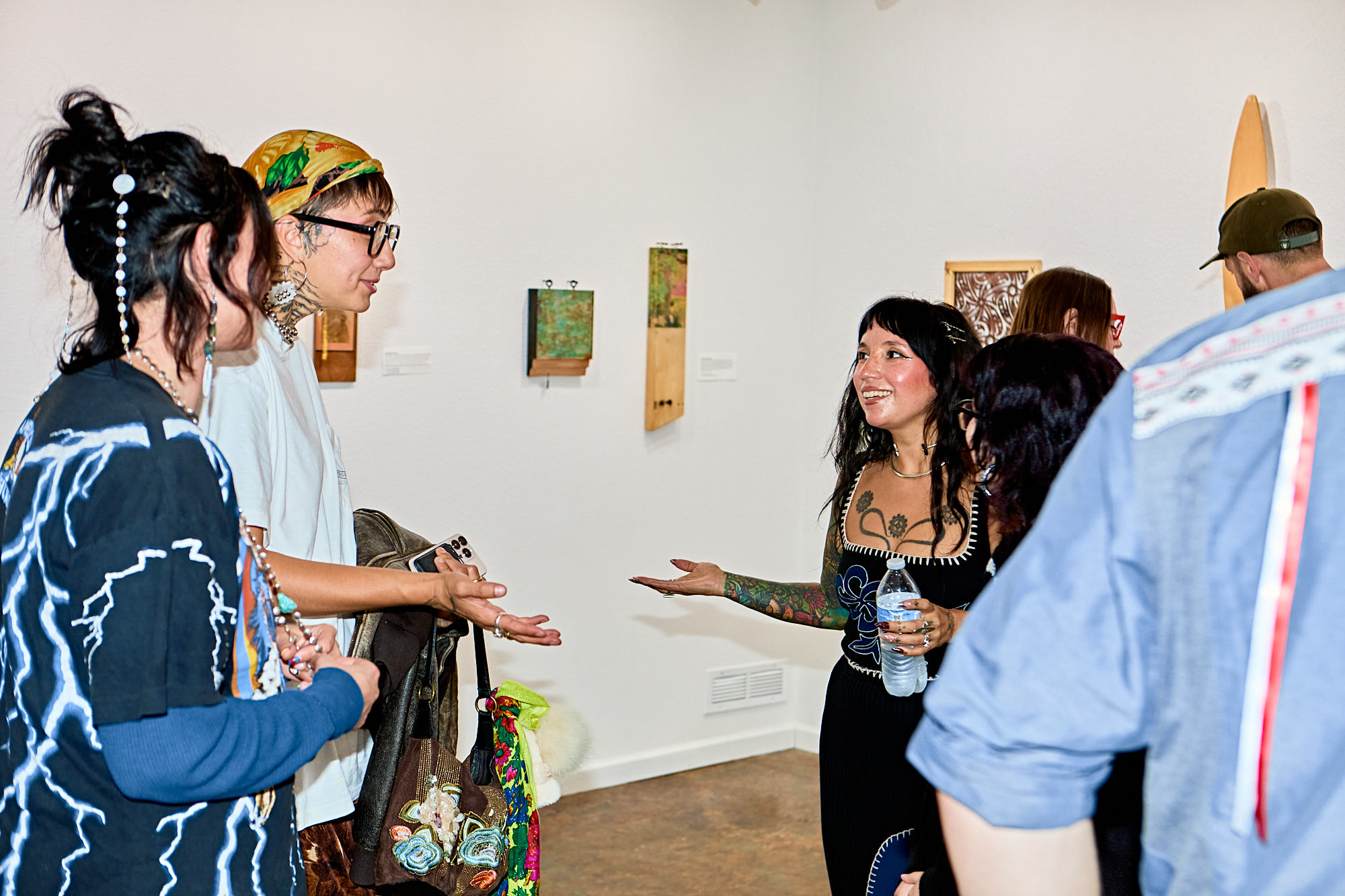
Photo by David Hoekje of The Land Remembers opening party featuring the curator Mikaela Shafer.